
Moving to France
The India–France corridor serves professionals, students and families from Mumbai, Bengaluru and Delhi heading to Paris, Lyon and beyond. Seemleius manages the India end and the French arrival.
- 20+ years moving households & cargo
- 184 countries destination corridors covered
- In-house customs clearance filed by our own team
- One coordinator from quote to delivery
France sits at an interesting intersection for Indian emigrants. On one side, it is a significant professional destination: Paris draws Indian professionals in consulting, finance, luxury goods and the arts; Lyon attracts those in pharmaceuticals, biotechnology and engineering. On the other side, France has a long-standing Indian diaspora and a warm relationship with India across culture, cuisine and academia — which means the move is often less a leap into the unknown and more a transition into a familiar-feeling place, even for first-time emigrants.
The physical move, however, runs on very specific infrastructure: Indian export clearance from Nhava Sheva, Chennai or another Indian port; a sea voyage of four to five weeks to Le Havre or Marseille; French customs clearance; and onward road delivery to wherever in France the family or professional is headed. The India side is where most coordination errors happen on this corridor — and where Seemleius places as much attention as the French end.
The India–France strategic relationship
India and France have built a strategic partnership over four decades — defence procurement, civil nuclear cooperation, space collaboration through CNES and ISRO, and a growing commercial tie that runs across IT services, aerospace and pharmaceuticals. Toulouse and Bengaluru both function as aerospace clusters; Airbus has a substantial Indian engineering footprint and the reverse flow into Toulouse is now routine. The Pondicherry connection — a former French territory where some families still hold French nationality and where ties to metropolitan France span generations — gives this corridor a depth that few India–Europe routes match.
The India–France freight corridor
Le Havre, on France’s northern Atlantic coast, is the primary sea-freight entry point for shipments into Paris and northern France. Container vessels from Nhava Sheva (JNPT) and Mundra call regularly, and transit times from western India are approximately 22 to 28 days. Marseille and the adjacent Fos-sur-Mer terminal, France’s major Mediterranean ports, are strong alternatives for shipments from South India — Chennai Port to Marseille is a natural routing with reasonable transit times. Air freight from Mumbai (BOM), Delhi (DEL), Bengaluru (BLR) or Chennai (MAA) into Charles de Gaulle (CDG) or Lyon Saint-Exupéry (LYS) serves moves where the timeline is pressing — Air France, Vistara and Air India operate the direct BOM/DEL to CDG sectors at roughly nine to ten hours.
What makes this corridor distinctive from the India side
Indian export clearance
Shipping bill filed on ICEGATE with the correct AD code, packing list and export declarations — FEMA and GST refund considerations addressed at the India end before the shipment moves.
Two sea gateways into France
Le Havre for Paris and northern France; Marseille or Fos-sur-Mer for the south. The right port is chosen for your destination, not defaulted to the nearest Indian port.
French customs clearance
French Douane DELT’A entry, EORI, ICS2 advance manifest and Cerfa 10070 transfer-of-residence form prepared correctly — with 20% French VAT and duty relief assessed properly.
Single coordinator, both ends
The same person who oversees your packing in India manages the French delivery — one point of contact, no vendor handover gaps.
Who moves from India to France
- Professionals on employer-sponsored routes — Passeport Talent holders in IT and research, intra-company transferees within multinational groups, EU Blue Card recipients heading to Paris and Lyon; architects and designers drawn by France’s creative industries
- Students at French grandes écoles and universities — HEC, INSEAD, École Polytechnique, Sciences Po and the universities of Paris and Lyon attract Indian postgraduate students in significant numbers
- Families joining partners already in France — family reunification (regroupement familial) is one of the largest move categories on this corridor; often planned over years
- Indian business founders — entrepreneurs establishing French operations, particularly in technology, luxury goods and food and beverage
Where we deliver in France
Paris and the Île-de-France region; Lyon and Rhône-Alpes; Nice, Cannes and the Côte d’Azur; Marseille and Provence; Bordeaux; Toulouse, where the aerospace and Airbus presence draws Indian engineering families. If your French destination is a smaller city or a rural address, we deliver there too — the road network from Le Havre and Marseille extends across the whole country.
Starting the move from India
- Survey in India. We assess your household or office volume at your India origin city — in person or by video — and return a clear quote with sea and air options for your timeline.
- Prepare Indian export paperwork. Shipping bill on ICEGATE with the correct AD code, commercial invoice or household effects inventory, packing list and any FEMA declarations filed with Indian Customs before the shipment leaves.
- Pack and dispatch. Export-standard packing at the India end; shipment booked and dispatched from Nhava Sheva, Mundra, Chennai or Cochin.
- Clear in France and deliver. French Douane DELT’A entry, EORI used, Cerfa 10070 lodged where the move is a transfer of residence, then road delivery to your French address with unpacking.
Each guide below is built for a specific type of France move. Choose the one that fits, or request a quote and your coordinator will guide you from there.
What actually moves the price of an India to France move
Two families shipping from the same Bengaluru apartment block to the same Paris arrondissement can be quoted very differently, and the reason is almost never the distance. Volume is the first variable — a container is sold by the box, so the gap between filling three-quarters of a 20ft and having to break into a 40ft is a step change, not a gradual climb. Access is the second. A ground-floor villa in Whitefield with a driveway loads in a morning; a fourth-floor flat in a Mumbai building whose service lift is out of action does not, and neither does the French end if the delivery address turns out to sit above a stairwell a wardrobe cannot physically pass through.
After those two, the variables get less obvious.
- Which Indian port the consignment leaves from. Nhava Sheva and Mundra carry the deepest schedules towards Le Havre; Chennai and Cochin feed the Mediterranean rotations into Marseille-Fos. Trucking a Hyderabad shipment to the wrong coast to catch a cheaper ocean rate rarely pays for itself once the road leg is counted.
- Sole use against a shared load. A shared container is cheaper on paper and slower in practice, because it waits for consolidation at the Indian end and for deconsolidation at the French one.
- Crating. Marble tops, glass, mirrors, temple pieces and any solid-wood item with a carved or turned face need timber crates rather than cartons. Crating is a visible line on the quote and it is the line that most often prevents a claim.
- The French delivery address. Le Havre to Paris is a short run; Le Havre to a hamlet in the Dordogne is not, and a village street a full trailer cannot enter means a shuttle in a smaller vehicle.
- Season. Ocean rates on the Asia to North Europe leg move, and so does capacity out of India ahead of the monsoon and around the pre-Diwali rush.

A realistic calendar, from the first call to the last carton
The most common planning error on this corridor is treating the sea voyage as the length of the move. The voyage is roughly three to four weeks of a process that runs closer to three months end to end. This is how the weeks usually distribute themselves.
| Stage | Typical duration | What is happening |
|---|---|---|
| Survey and quote | 3–7 days | Volume assessed at the Indian address in person or by video; sea and air options priced against the timeline. |
| Booking and documentation | 1–2 weeks | Shipping bill prepared on ICEGATE against the AD code registered at the departure port; inventory and packing list built. |
| Packing and collection | 1–3 days | Export packing at origin, with crating for fragile and high-value pieces. |
| Origin handling and sailing | 1–2 weeks | Haulage to Nhava Sheva, Mundra, Chennai or Cochin, customs formalities, cut-off, loading. |
| Ocean leg | 22–28 days | Direct or via a transhipment call; longer from South India into Le Havre than into Marseille-Fos. |
| French clearance | 3–10 days | Entry lodged with the Douane through DELTA against an EORI, with relief assessed where the move is a transfer of residence. |
| Delivery and unpacking | 1–2 days | Road leg from the port, access equipment where the building needs it, placement and debris removal. |
Air compresses the middle of that table rather than the whole of it. The paperwork at both ends takes the time it takes.
Août — the French month nobody warns you about
France genuinely stops in August. Not entirely and not everywhere, but enough that a delivery pencilled in for the second week of the month can find the building manager away, the syndic office closed, the neighbourhood boulangerie shuttered behind a handwritten note, and the lift engineer who was going to release the service lift unreachable until September. Small firms and artisan trades close for two to four weeks at a stretch; the motorways clog on the changeover weekends at the end of July and the start of August, which the national traffic service colours black on its forecast calendar.
The practical consequence for a move out of India is simple. If the shipment lands in France in the first half of August, plan for the delivery to slip. Where the family’s own start date falls in early September — and many do, because the school year and the general return to work both begin in the first week — a sailing that leaves India in June and clears in mid-July leaves room for the delay without wrecking the arrival. The alternative, a July departure from India arriving into the August lull, is the version that generates anxious phone calls.
At the Indian end the calendar has its own shape. The south-west monsoon runs from June to September across the west coast, and Chennai catches the north-east monsoon between October and December. Neither stops a shipment, but both change how packing has to be done and how much buffer a road leg deserves. Late October and November are busy months out of India and capacity tightens accordingly.
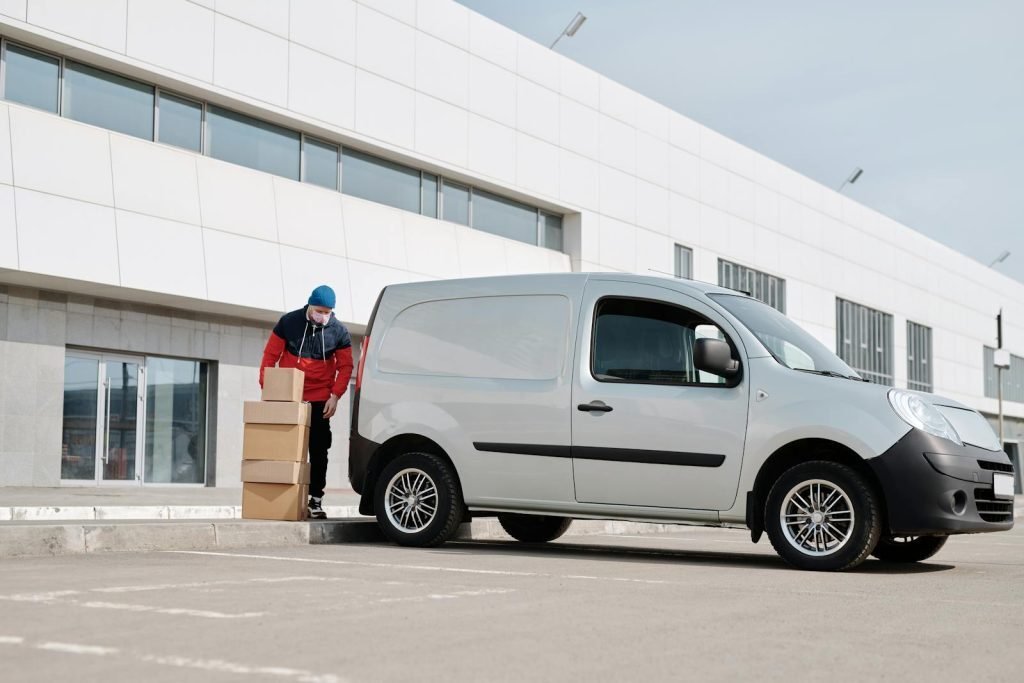
Getting a container’s worth of furniture up a Paris stairwell
French housing stock is old, handsome and hostile to furniture. A Haussmannian building has a stone spiral stair with a tight turn at every half-landing, a lift added a century after it was built that takes two people and a shopping bag, and a courtyard entrance under a carriage arch that sets a hard ceiling height for anything on wheels. None of this is a problem if it is known before the truck arrives. All of it is a problem if it is discovered on the day.
The French answer is the monte-meubles — an external ladder hoist mounted on a truck, which lifts furniture through a window or onto a balcony floor by floor. It is ordinary practice in French cities, it is what local crews reach for without being asked, and it needs two things arranged ahead: the hoist itself, and permission to occupy the kerb outside the building, which the mairie grants as a street-occupation authorisation. In central Paris that authorisation is not same-day. Booking the hoist and the kerb space at the same time as the delivery slot is the difference between a two-hour delivery and a wasted Saturday.
Where the French address is not ready — the lease starts later than the ship does, which happens often on this corridor — the consignment can be held in storage near the port of entry and released once the keys exist.
What people ask before they commit to a France move
How far ahead should the move be booked?
Six to eight weeks before the intended sailing is comfortable for a household consignment. If an animal is travelling, that number stops being the constraint entirely: the EU entry sequence for a pet coming from India runs to several months and should begin as soon as France is a decision rather than an idea. The pets and vehicles guide sets out why.
Can part of the shipment go by air and the rest by sea?
Yes, and on this corridor it is often the sensible answer. A small air consignment out of BOM, DEL, BLR or MAA into CDG or LYS carries the laptops, the school files, a season of clothes and the kitchen essentials; the sea container carries everything else and arrives a month later. It costs more than a single sea shipment and a great deal less than flying the whole house.
Does everything really need to be listed?
Yes. The inventory is not a formality — it is the document the Douane reads, it is the basis of the transit cover, and it is what a claim is settled against. Every carton is numbered and its contents recorded at the Indian end before it is sealed.
What if the French address changes mid-transit?
Tell your coordinator as early as you can. A change of delivery town while the vessel is at sea is usually absorbable; a change of country is not, because the entry has been built against a French address. Late changes cost storage and a second road leg rather than the whole shipment.
Is a 20ft or a 40ft the right size?
A 20ft suits most two-bedroom households once the largest furniture has been thinned out; a family home with wardrobes, a dining set, beds and a study generally needs a 40ft. The survey settles it, and it pays to be honest during the survey about what is genuinely coming. A container that turns out to be too small on packing day is the most expensive mistake available on this corridor.
Your move to France, your way
Every move is different. Pick the guide that matches your situation for advice and pricing built around it.
Commercial Cargo & Freight to France
Commercial cargo and freight from India to France — sea from Nhava Sheva or Chennai into Le Havre or Marseille,…
Read the guideCorporate & Office Relocation to France
Relocating a business or office from India to France — Indian commercial export clearance, sea freight to Le Havre, and…
Read the guideEmployee Relocation to France
Employee relocation from India to France, designed for HR and mobility teams — Indian export clearance per employee, French customs…
Read the guideHousehold & Personal Moves to France
Moving your household from India to France — export-packed from your India city, shipped through Le Havre or Marseille, and…
Read the guidePets & Vehicle Relocation to France
Relocating pets and vehicles from India to France — India export formalities, EU animal entry requirements and vehicle freight managed…
Read the guide