
Household & Personal Moves to the United Kingdom
Household and personal relocation from India to the United Kingdom — your goods packed at your Indian home, exported through the correct gateway, cleared into the UK and delivered.
A household move from India to the UK is a significant undertaking at both ends. At the India end, goods must be packed, inventoried and exported through Indian customs via a properly filed ICEGATE Shipping Bill. At the UK end, they must clear British customs as duty-free personal effects under HMRC’s Transfer of Residence (ToR1) relief, and reach a specific delivery address that is often in one of the long-established Indian neighbourhoods — Wembley, Southall, Harrow or East Ham in London; Belgrave Road in Leicester; the Soho Road area of Birmingham; the Indian belt of south Manchester. In between there is a sea transit of roughly 22 to 28 days from Nhava Sheva to Felixstowe, Southampton or London Gateway, or for smaller and urgent shipments, a nine to ten hour air leg from BOM, DEL, BLR, MAA or COK to Heathrow. Seemleius household and personal relocation on this corridor manages the entire chain — one coordinator, both countries, no gaps between them.
Starting in India: the export process
Most people are surprised to find that moving personal effects out of India requires real customs attention. The export of household goods is a permitted category, but it requires a correctly filed Shipping Bill on ICEGATE, the freight forwarder’s AD code linked to the relevant bank, a detailed item-level inventory, and supporting documentation about the owner’s residence shift. Where any FEMA implication arises, that is captured cleanly; where a GST LUT or input refund position needs to be considered for the forwarder’s leg, we deal with it at the back end. We prepare all of this before your goods are packed, so the export paperwork is ready before anything goes into a carton and there is no delay at the port.
Your origin city determines the gateway. If you are in Mumbai or wider MMR, the natural departure point is Nhava Sheva (JNPT). From Ahmedabad or Surat the route runs through Mundra. From Bengaluru, Hyderabad or Chennai itself, Chennai Port is often the right choice. From Kochi and the wider Kerala region — a heavy NHS-bound emigration source — Cochin is the departure port. We route from your actual address, not from a centralised hub.
Settling in: where Indian families land in the UK
Deliveries on this corridor land across a familiar set of UK locations. London absorbs the largest share — West London (Wembley, Harrow, Southall and the Brent / Ealing belt), East London (Ilford, East Ham and Newham), and the South London Indian communities. Leicester remains one of the most established Indian cities outside India, with deliveries clustered around Belgrave and Rushey Mead. Birmingham takes a substantial share through Soho Road, Handsworth and the wider West Midlands corridor. Manchester, Bristol and the Scottish central belt are all regular destinations. We coordinate the UK delivery in your specific neighbourhood, including parking permits, narrow-access streets and apartment-block restrictions where they apply.
What we move
- Furniture of all kinds — wooden and upholstered pieces wrapped and dismantled for transit, reassembled on delivery
- Electronics and appliances — voltage and plug compatibility noted for the UK’s 230V / 50Hz, BS 1363 standard
- Fragile items, art, mirrors and heirlooms — individually packed and crated to export specification
- Clothing, books, kitchenware and the everyday contents of family life
- Sentimental and religious items — murti, brass utensils, family puja items — declared correctly so they clear without question
Freight choices on this corridor
Full container (FCL)
Your container, your goods only — the right choice for a large household. Roughly 22 to 28 days Nhava Sheva to Felixstowe or London Gateway.
Consolidated (LCL)
Share a container for a smaller volume — cost-effective for one or two-bedroom households out of India.
Air freight
BOM, DEL, BLR, MAA or COK direct to LHR on BA, Virgin, Air India or Vistara — for essentials and items you need before the sea shipment arrives.
Split shipment
Air a small priority box; sea the rest. Practical for people who arrive in the UK weeks before the main shipment lands.
UK customs and ToR1 relief
The United Kingdom allows duty-free import of personal and household effects under HMRC’s Transfer of Residence (ToR1) relief when the importer is shifting their main residence to the UK and the goods have been owned and used abroad for at least six months. The ToR1 application must be made to HMRC before the goods arrive at the UK port; the resulting unique reference goes onto the CDS import declaration so customs can match the relief to your shipment at clearance. Late applications, gaps in the inventory or mismatched ownership periods trigger queries and potential duty assessments. We prepare and submit the full ToR1 application on your behalf, well in advance.
Life admin once you arrive
Practical things to line up alongside the move: register with an NHS GP in your new postcode (this is free and the gateway to most healthcare), apply for a National Insurance number if you have not already, and understand UK tax residence — you become UK tax resident broadly after 183 days in a tax year or sooner under the Statutory Residence Test if other ties apply. For families with school-age children, state-school admissions run on catchment-area allocations through the local authority; independent (private) school admissions typically run on a 12 to 18 month cycle with entrance tests for the more selective schools. The Indian grocery, temple and gurdwara networks across the UK’s major cities are extensive — settling in culturally is rarely the hard part.
How your household move runs
- Home survey. We assess your home in India — in person or by video call — and return a clear quote with sea and air options, transit estimates and the ToR1 timeline explained.
- ToR1 and export preparation. Your Transfer of Residence application is prepared and submitted to HMRC; the Shipping Bill on ICEGATE and the inventory are built and verified item by item.
- Pack and dispatch. Our crew packs to export standard at your Indian home, finalises the inventory, and dispatches from the correct India gateway.
- UK clearance and delivery. We manage UK customs clearance under CDS with ToR1 relief at Felixstowe, Southampton or London Gateway, and coordinate delivery, unpacking and placement at your UK address.
The ToR1 process and Indian export step both reward early preparation. Request a quote and we will work backwards from your UK arrival date to build a schedule that fits.
The quote, decoded
Every household quote on this corridor is built from the same handful of ingredients, and knowing them helps you read yours. Volume dominates — the cubic measure of what you ship sets the container decision and most of the freight cost, which is why the survey is worth doing carefully rather than optimistically. Access comes next, at both ends: a lift-served flat in Powai loads differently from a fourth-floor walk-up in an older Kochi building, and a Wembley terrace with permit parking delivers differently from a Surrey driveway. Then the mode split, the season — monsoon packing consumes more protective material, and peak sailings cost more — and finally insurance, which is priced on the value you declare item by item. Storage, if your UK dates need it, appears as its own line rather than hiding in the rate.
What the quote deliberately excludes: anything resembling a per-kilo parcel tariff. This is a full household service with export packing, customs handling at both ends and delivery to room — a different product from freight-by-weight, and priced as one.

Pack it or leave it — a candid list
Two decades of this corridor have taught us what earns its ocean passage. Solid-wood furniture travels beautifully and would cost multiples to replace in the UK; so do brass and bronze pieces, stainless kitchenware, books, and the sentimental core of any household. Your kitchen machines make the cut too — the mixer-grinder, the wet grinder, the pressure cookers — because India and Britain share a 230-volt supply, and a plug change is all they need.
The think-twice column is just as real. Mattresses seldom justify the space: British bed sizes differ from Indian ones, so a shipped mattress often fits no frame you can buy locally. Ageing refrigerators and washing machines are marginal — freight plus the risk of a compressor that dislikes six weeks at sea can exceed the price of a newer machine in the UK. Voltage stabilisers and inverters, essential at home, are dead weight on a stable British grid. And three things stay behind without debate: the kitchen LPG cylinder, anything flammable, and meat or dairy foods — ghee included — which cannot enter Great Britain in a personal shipment from India. Dried spices, pulses, pickles and packaged dry foods are generally fine when declared on the inventory; whole seeds and live plants are restricted. High-value jewellery should fly with you, insured, rather than sail in a box.
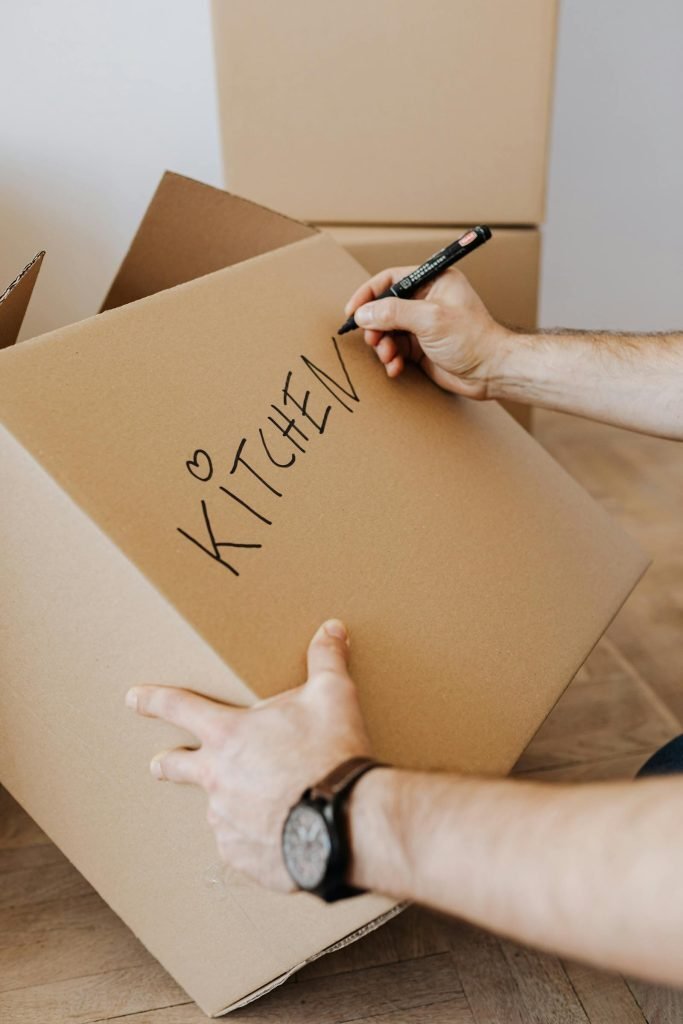
A week-by-week picture
Families cope better with this move when they can see its shape in advance. Working back from your flight, a comfortable schedule looks like this:
| When | What happens |
|---|---|
| Eight weeks before flying | Survey at your home, quote agreed, sailing pencilled in |
| Six weeks | Transfer of Residence application submitted; inventory drafted; ship-or-leave decisions closed |
| Four weeks | Packing date fixed; school records, warranties and manuals gathered into the documents box you carry yourself |
| Two weeks | Export packing at home, container dispatched to the gateway port |
| Your flight | You travel while the goods are on the water |
| Three to five weeks after arrival | Vessel docks, customs clearance completes, delivery is booked to your new address |
Compressed versions of this schedule work — we run them constantly — but each week removed takes an option with it, and the relief application is the step that most rewards being early.
When the dates refuse to line up — storage on both sides
Real moves are rarely tidy. The Bengaluru flat has to be handed back before the UK tenancy exists; the family stays with grandparents in Kochi for a month between homes; the London house purchase drags past the vessel’s arrival. Storage is the shock absorber for all of it, and it works at either end of the corridor. Held in India, your packed consignment waits in a bonded-quality warehouse and sails when your UK address firms up — the sensible choice when the uncertainty is measured in months. Held in the UK, the goods clear customs on schedule and sit in secure storage a delivery-day’s notice from your door — the right answer when the gap is weeks and you want the ocean crossing behind you.
The cost logic differs at each end, and so does the paperwork rhythm, so this is a decision to take with your coordinator rather than by default. What we counsel against is the third option people drift into: rushing a tenancy or a purchase to meet a container. Homes outlast shipping schedules; choose the home and let the shipment wait.
Four questions families ask
Will my appliances actually work in the UK?
Almost all of them. Both countries run 230 volts at 50 hertz, so televisions, kitchen machines and computers need only a BS 1363 plug or an adaptor. The exceptions are appliances plumbed for Indian fittings — check before shipping a water purifier — and any fridge, which must travel and rest upright before switch-on.
Do I pay UK tax on my own used belongings?
Not when Transfer of Residence relief is approved: it relieves both customs duty and import VAT on qualifying personal effects you have owned and used abroad. That is why the application timeline gets so much attention in our process — the relief is generous, but only for shipments that arrive with it already in place.
Can a relative receive the delivery if I am at work?
Yes — name them in advance and brief them on the inventory, and the crew will walk them through the carton count and placement exactly as they would with you. Many corridor deliveries into Leicester and West London are received by family who arrived a generation earlier.
How long will I live out of suitcases?
Realistically, three to six weeks between landing at Heathrow and sleeping in your own bed, depending on the sailing and how quickly your housing settles. A small air consignment shrinks the discomfort — it carries the pressure cooker, the children’s essentials and the first-week kitchen while the sofa is still at sea.
What about the puja room?
Murtis, framed deities, lamps and the contents of a family shrine travel in their own carefully labelled cartons, packed last and unpacked first if you ask — many families do. Declare them plainly on the inventory as religious articles for personal use and they clear without comment. Items containing ivory or certain animal materials are the exception and need checking before packing day, not at the port.