
Corporate & Office Movers and Packers to Qatar
Relocating an office from India to Qatar — Indian export clearance, sea freight to Hamad Port and operational delivery in Doha handled from start to finish.
Qatar’s post-2022 economic expansion has drawn Indian companies into Doha across multiple sectors: technology, construction, hospitality, healthcare and professional services. Establishing or expanding a Qatar operation from an Indian base involves a specific set of logistics challenges — not least that commercial equipment moving out of India requires formal export clearance, and that the sea voyage to Hamad Port adds a transit window that has to be built into the operational plan. Seemleius corporate and office moving service from India to Qatar manages both, so the business side of the expansion is not held up by the freight side.
Indian company into Qatar: the structural choice that shapes the freight plan
Before the first crate is packed in Mumbai or Bengaluru, the Indian parent has usually made a structural decision about how the Qatar entity is registered — and that decision shapes the freight plan. The two common routes are an LLC registered under the Ministry of Commerce and Industry (MOCI), which historically required a majority Qatari shareholder — though Law No. 1 of 2019 opened most sectors to up to 100% foreign ownership, subject to ministry approval, or a 100% foreign-owned entity inside one of the Qatar Free Zones, typically QFZA (Qatar Free Zones Authority) at Ras Bufontas or Umm Alhoul, where Indian-owned tech, logistics and light-industrial operations have set up extensively. The customs treatment, the address the cargo is consigned to, and the eventual delivery point all flow from this choice. We work to whichever structure the Indian parent has chosen.
Commercial goods leaving India: the export compliance layer
Business equipment, IT infrastructure and commercial assets moving from India to Qatar are formal exports under Indian customs law. An accurate shipping bill is filed on ICEGATE for every consignment — with correct HS code classification, declared values, AD code registered against the exporter and a GST LUT in place for zero-rated treatment. Errors at this stage create problems at Hamad Port that take days to resolve, with storage costs accumulating the whole time. We prepare the Indian export documentation accurately from the start, and it means the Qatar clearance through Al Nadeeb is straightforward.
What we move and how
Office furniture & interiors
Workstations, storage, conference furniture and specialist fit-out items packed, sea-freighted from Nhava Sheva, Mundra or Chennai and reassembled to your Doha floor plan in West Bay, Lusail or the QFZA campus.
IT infrastructure & sensitive kit
Servers, terminals and networking hardware handled under a strict protocol — individually packed, sequenced for restart and air-freighted on the 3.5–4 hour BOM/DEL/BLR to DOH leg when transit time is critical.
Commercial stock & operational goods
Commercial imports into Qatar classified and valued correctly at the India end, with HS codes that align with Qatar tariff treatment, avoiding the clearance holds that push back operational timelines.
Doha delivery scheduling
We coordinate delivery windows around your Qatar office building access — particularly relevant for new developments in Lusail, West Bay and the QFZA campuses with shared loading facilities and weekend (Fri–Sat) closures.
Where Indian companies actually land in Doha
Three clusters dominate. West Bay is Doha’s established financial and corporate district, anchored by the Qatar Financial Centre (QFC) towers, and remains the default for finance, professional-services and headquarters operations. The QFC’s own platform is a separate regulatory environment that some Indian financial-services firms have adopted. Lusail, the newer mixed-use city north of West Bay, has absorbed a significant share of post-World Cup corporate occupiers — Marina District towers, Lusail Boulevard offices and recently completed Grade-A floor plates that opened up office availability that simply did not exist before 2022. QFZA at Ras Bufontas (next to Hamad International) and Umm Alhoul (next to Hamad Port) is where 100% foreign-owned Indian tech, light-manufacturing and logistics entities tend to sit. The freight delivery and the customs treatment differ between these zones, and we plan for the destination from the start.
Operating week, Qatarisation, and the calendar
One small but consequential note for Indian businesses arriving in Qatar: the weekend is Friday and Saturday, not Saturday and Sunday. Coordination with the Indian parent on a Friday is limited; Sunday is a full working day in Doha. Qatarisation policy, which sets minimum Qatari-national employment thresholds in certain sectors, also shapes the HR plan but does not directly affect the freight side. We schedule deliveries, clearance windows and installation around the Qatari working week, not the Indian one.
Sea and air: choosing the right split
For a corporate move from India to Qatar, the freight plan almost always involves both modes. The bulk of the furniture and equipment moves by sea from Nhava Sheva, Mundra or Chennai to Hamad Port — a 10–14 day transit, cost-effective and capable of handling large volumes. The IT infrastructure, sensitive systems and the items needed for day one of operations often move by air from Mumbai, Delhi or Bengaluru directly to Hamad International Airport. We recommend the split that keeps your operational start date intact.
How a corporate move from India runs
- Survey in India. We assess the India premises, confirm what ships and what does not, identify the access and constraints at the Doha destination (West Bay, Lusail or QFZA) and build a freight and delivery plan.
- Prepare the Indian export. Shipping bill filed on ICEGATE, AD code registered, GST LUT applied, Indian customs clearance obtained, freight booked from the relevant Indian port and airport.
- Transit to Doha. Sea freight travels to Hamad Port; air freight arrives at Hamad International. Your coordinator tracks both legs.
- Clear and install in Qatar. Qatar customs clearance via Al Nadeeb at Hamad Port managed; delivery and installation at the Doha office to your floor plan so the team can start work from the first day.
Whether you are relocating a project office from Chennai to Doha or establishing a regional headquarters from Mumbai — under MOCI, the QFC or QFZA — the freight logistics should be the part that does not cause delays. Talk to us and we will plan it around your Qatar operational timeline.
The customs identity your Qatar entity needs before anything sails
An office move is a series of commercial imports, and Qatar assesses them against the receiving entity rather than against the sending one. Before the first crate leaves Bengaluru or Mumbai, the Doha entity needs a live commercial registration, an establishment card, an authorised signatory whose specimen matches what is filed, and a customs account through which declarations are lodged with the General Authority of Customs. Where the entity sits inside a free-zone campus, the zone authority sits in that chain too and the customs treatment of goods entering the zone differs from goods entering the domestic market.
The trap is a familiar one. A parent company in India commits to an office opening date, books a fit-out crew, signs a lease and starts shipping — while the Qatari registration is still working through its own steps. The freight arrives correctly and cannot be cleared, because there is no eligible importer of record on the declaration. Storage at Hamad Port then bills daily against a project that has not opened. The remedy is dull and effective: confirm the Doha entity’s customs identity is live, then release the freight, and use storage in India for the gap if there is one. Origin storage is the cheaper side of that trade every time.
Sequencing the fit-out against the sailing
A Doha office opening runs on two clocks that have to be brought into line. The property clock covers lease signature, landlord approvals, contractor mobilisation, MEP work and the building’s own handover process. The freight clock covers survey, export documentation, packing, the road leg to the Indian port, the sea passage, clearance and delivery. They are similar in length, which is why they are so often run in parallel by accident and collide at the end.
The workable order is to fix the date the floor can physically receive goods first, then count backwards. Delivery and installation want a fortnight of contingency ahead of the operational start date, not two days. Clearance at Hamad Port wants a few working days beyond the vessel arrival. The sea leg from Nhava Sheva, Mundra or Chennai wants the transit band plus a berth allowance. Packing and export documentation want a week or more before that. Working from a realistic receive-date rather than an aspirational launch date is the single change that keeps corporate moves on this corridor calm.
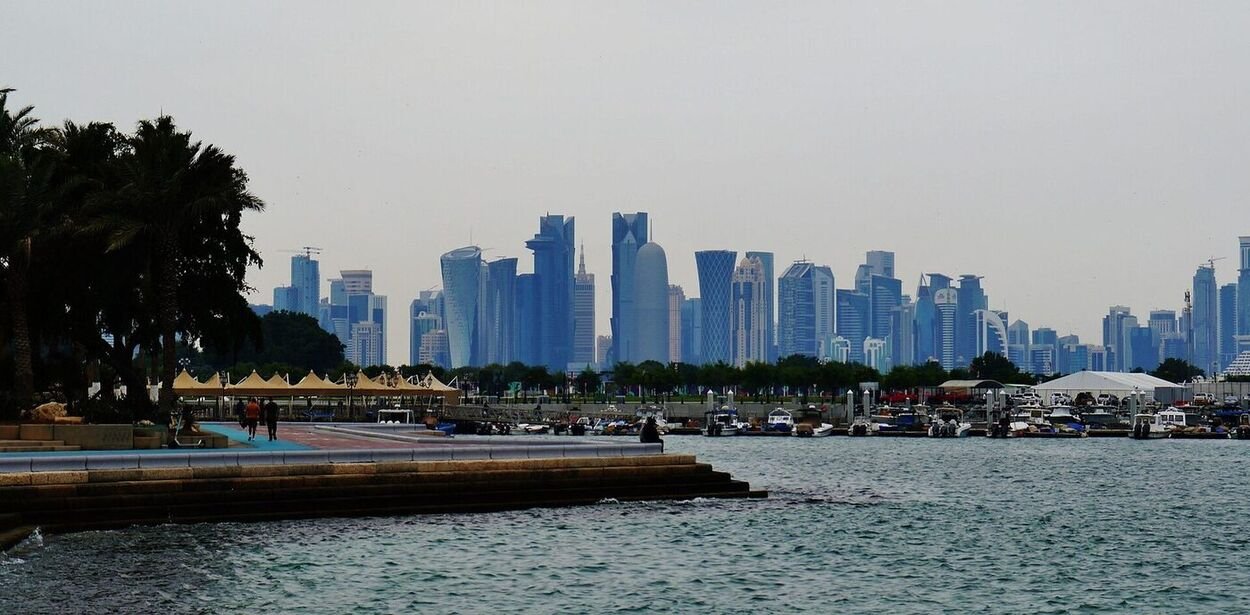
Getting a lorry-load of office into a Doha tower
Delivering into a West Bay or Lusail tower is a scheduled operation rather than a drive-up. Building management controls the goods lift, and it is booked in advance for a defined window with a named crew, often outside core business hours so that tenant lifts are not disrupted. Loading bays are shared between tenants and contractors, so a slot missed is a slot lost to somebody else. Site access usually requires the crew and the vehicle to be lodged with building security ahead of the day, with identity documents matching the list at the gate. Waste is its own constraint: a full office fit-out generates a substantial volume of cartons and packing material, and buildings have firm rules about where it goes and who removes it.
Free-zone campuses near Hamad International and Hamad Port run to a different rhythm again, with their own gate procedures and, in some cases, restrictions on when goods may move between zone and domestic customs territory. We survey the destination access as part of the plan, not on the morning of the delivery, and the delivery method statement is agreed with building management before the container leaves the port.
Heat, dust and what should not travel by sea in July
A container crossing the Arabian Sea in high summer becomes an oven, and Doha’s ambient conditions at the far end do not offer much relief. Most office contents are indifferent to this. A few things are not, and they are worth pulling out of the sea consignment and sending by air: sealed lead-acid and lithium battery stock, uninterruptible power supplies, certain adhesives and printer consumables, laminated or veneered furniture with glue lines that can creep, musical or laboratory instruments, and anything with a manufacturer-stated storage temperature range. Archive paper and photographic material suffer more from humidity than from heat, and travel better in a sealed, desiccated pack.

Closing the Indian office properly
The Doha end gets the attention, but the Indian end is where the audit trail is built. Assets leaving India are exports, and the asset register has to reconcile to the shipping bill: what shipped, what was sold locally, what was scrapped, what stayed. Capitalised IT equipment that leaves the country changes its position in the books, and finance will want the export documentation to support it. Electronic waste has its own disposal route in India and cannot simply be left with a landlord. Leases, telecom accounts and utility connections need closing rather than abandoning, because a dormant Indian liability has a way of surfacing during a later audit of the group.
We produce a single reconciliation covering the Indian premises — shipped, stored, sold, disposed — against the inventory taken at survey. It is not glamorous work, but it is what makes the corporate file defensible a year later when somebody asks where a particular asset went.
Questions from Indian companies opening in Doha
Is it cheaper to ship the existing office or buy new in Doha?
It depends almost entirely on what the furniture is. Standard workstations and task seating rarely justify the freight, the duty and the reassembly labour when equivalent stock is available in Doha. Bespoke joinery, boardroom furniture, branded reception elements and specialist technical equipment usually do, because replacing them means re-specifying and re-manufacturing. The honest answer for most offices is a split: ship the things that are hard to replace, buy the things that are not, and use the survey to draw the line with numbers rather than instinct.
Can equipment go to Qatar temporarily and come back?
Yes, and that is a different customs route from a permanent import. Demonstration equipment, exhibition stands and test gear can travel under temporary-admission arrangements so that duty is not paid on goods that are leaving again. The discipline is that the consignment has to balance on return, item for item, against what went in.
How much of the move can happen before the Doha lease is signed?
The survey, the shipping plan, the export documentation and the packing can all be completed in India. What cannot happen is arrival without a place to deliver to. Holding a packed, export-ready consignment in Indian storage while the lease closes is a normal and inexpensive part of this corridor, and it is a far better position than a cleared container circling Doha looking for a floor.