
Household & Personal Moves to Qatar
Moving your home from India to Qatar by sea to Hamad Port — Indian export clearance, sea freight, GCC customs and door-to-door delivery in Doha.
The India–Qatar household move follows a particular rhythm. There is usually a job offer, a start date that is fixed — and then the challenge of getting a household from India to Doha in time and in order. Seemleius household and personal moving service from India to Qatar is built around that rhythm: the Indian export side handled as a formal process, the sea freight to Hamad Port coordinated with the Doha delivery, and one coordinator holding the whole thing from your Indian home to your Qatari address.
Why the Indian export process sets the pace
On the India–Qatar corridor, the sea voyage itself is a fixed variable. What is variable — and what often delays moves unnecessarily — is the Indian export clearance step. Personal effects and household goods leaving India are treated as a formal export under Indian customs rules. A shipping bill is filed on ICEGATE, the goods are declared and inventoried, an AD code is registered against the exporter, FEMA valuation rules are observed and customs clearance must be obtained at the port or Inland Container Depot before loading. We manage this process as a routine part of every move — but it needs lead time, and it is the reason we ask for as much notice as possible at the India end.
Our Indian origin expertise covers all the main departure points:
- Nhava Sheva (JNPT), Mumbai — the natural port for households in Mumbai, Pune and western Maharashtra
- Cochin, Kerala — the gateway for Kerala’s large and established Qatar-bound community
- Chennai Port — serving Tamil Nadu, Andhra Pradesh, Telangana and the southern corridor
- Mundra, Gujarat — efficient for Ahmedabad, Surat and the Gujarat region
Where Indian families settle in Doha
Doha is compact, but Indian families gravitate towards a recognisable handful of neighbourhoods, usually chosen for proximity to an Indian school, an established community or a workplace. Al Sadd and Al Waab are long-standing favourites for middle-income Indian families, with mosques, Indian grocery outlets and family-run restaurants well embedded. West Bay and The Pearl draw senior executives and finance professionals, with apartment living and proximity to Lusail. Al Wakra to the south — close to Hamad International Airport and the Hamad Port hinterland — suits families working in the southern industrial belt. Lusail itself, the newest of Doha’s districts, is increasingly attractive to Indian arrivals after the 2022 build-out. Malayali concentrations are visible across Al Sadd and Al Waab, Tamil and Hyderabadi communities are well represented in Old Airport Road and Bin Mahmoud, and Gujarati families anchor pockets of West Bay and Lusail.
Indian schools in Doha — the practical anchor
For most Indian families, the school decision drives the housing decision. Doha hosts a strong cluster of Indian-curriculum schools running CBSE, ICSE and Kerala state boards, and admissions windows tend to set the household move timeline rather than the reverse. MES Indian School (Indian Educational School) is one of the oldest and largest. DPS Modern Indian School in Wakra is well regarded for CBSE secondary. Birla Public School, Bhavans Public School and the Ideal Indian School round out the most-sought-after list. Capacity is tight, and admissions for the April–March Indian academic year close earlier than families often expect. We plan the freight timeline around school start dates, not the other way around.
What moves in the shipment
A full household shipment from India to Qatar is the complete contents of a home, handled with the care the sea voyage demands:
- Furniture — dismantled where needed, wrapped and crated for the sea journey, reassembled at your Doha address
- Fragile items, ceramics, art and mirrors — individually cushioned and crated to export standard
- Appliances and electronics — checked, carefully packed and documented with voltage and specification details relevant to Qatar (240V, Type G/D plugs)
- Clothing, books, kitchen goods and the contents of everyday family life
- Items of sentimental value — handled with the same deliberate care as the most fragile pieces
Getting your essentials to Doha first
Air freight for week-one essentials
Documents, key electronics, important clothing and immediate necessities sent by air from Mumbai, Delhi or Chennai — 3.5–4 hour flight on direct services — so you have what you need when you land in Doha, weeks before the sea shipment arrives.
FCL sea freight
A dedicated container from your Indian port to Hamad Port for larger households — a 10–14 day transit, your belongings travel together, customs is straightforward and the container can be sealed at your India address.
LCL consolidation
For smaller moves, your shipment is consolidated with other carefully packed cargo — cost-effective, with the same packing standard and documentation as a full container.
Storage at either end
If your Doha apartment or villa is not ready when the sea shipment arrives, we hold it securely at the port or in local storage rather than forcing you to rush the move-in.
At the Doha end: Hamad Port to your address
Once the sea freight arrives at Hamad Port, we manage Qatar customs clearance for household goods and personal effects through the Al Nadeeb Single Window. Personal-effects clearance is well established under GCC procedure; clearance is smooth when the documentation prepared at the India end is accurate and complete, which is always our starting point. Delivery from the port to your Doha address — whether that is an Al Sadd apartment, a Wakra townhouse or a Lusail compound villa — follows, with unpacking and furniture placement included so you arrive to a home rather than a container’s worth of cartons.
How your household move runs
- Survey in India. We assess your home, confirm the volume, recommend sea freight mode and the air freight scope for essentials, and return a fully costed quote.
- Prepare the export. Shipping bill on ICEGATE, AD code, FEMA-compliant inventory and Indian customs documentation prepared before packing begins.
- Pack and ship. Export-standard packing at your India address; shipment dispatched from the relevant Indian port or airport.
- Clear and deliver in Doha. Qatar customs at Hamad Port managed via Al Nadeeb; delivery to your Doha address with unpacking and furniture placement.
From a single room in Hyderabad to a full villa move from Bengaluru, one coordinator holds the move from the India survey to your Doha door. Request your quote and we will plan it from your India departure date.
The pantry, the medicine cabinet and the garage shelf
Most of what stops a household consignment at Hamad Port is not furniture. It is the small things that were packed without much thought, and on the Qatar corridor there is a specific list of them worth walking through before the packers arrive.
Alcohol is prohibited in an imported consignment, without exception and regardless of quantity or how it is packed. Pork and pork-derived products are prohibited, and Indian kitchens sometimes hold items with porcine gelatine in them without the label making that obvious. Recorded media, artwork and printed material are reviewed on arrival, and anything that could be read as offensive to Islamic values is not admitted. Beyond Qatari import rules, the shipping line imposes its own: aerosols, paints, thinners, adhesives, camping gas, LPG cylinders, lighter fuel, fireworks and pool chemicals are dangerous goods and do not travel in a household container from any origin. Nor do opened food packets, fresh produce, seeds, plants or soil, which attract agricultural attention as well as pests.
Spices, dry pulses, sealed packaged food and tea are ordinarily fine, and Indian families ship them from Kerala and Tamil Nadu routinely, though sealed original packaging and an honest inventory line make the difference between a glance and an examination. Prescription medicines should travel with the family in original packaging with the prescription rather than being buried in a carton. The rule of thumb is simple: if it burns, sprays, ferments, grows or has an ingredient list you have not read, take it out before the shipment is inventoried.
Getting the container into a compound or a Pearl tower
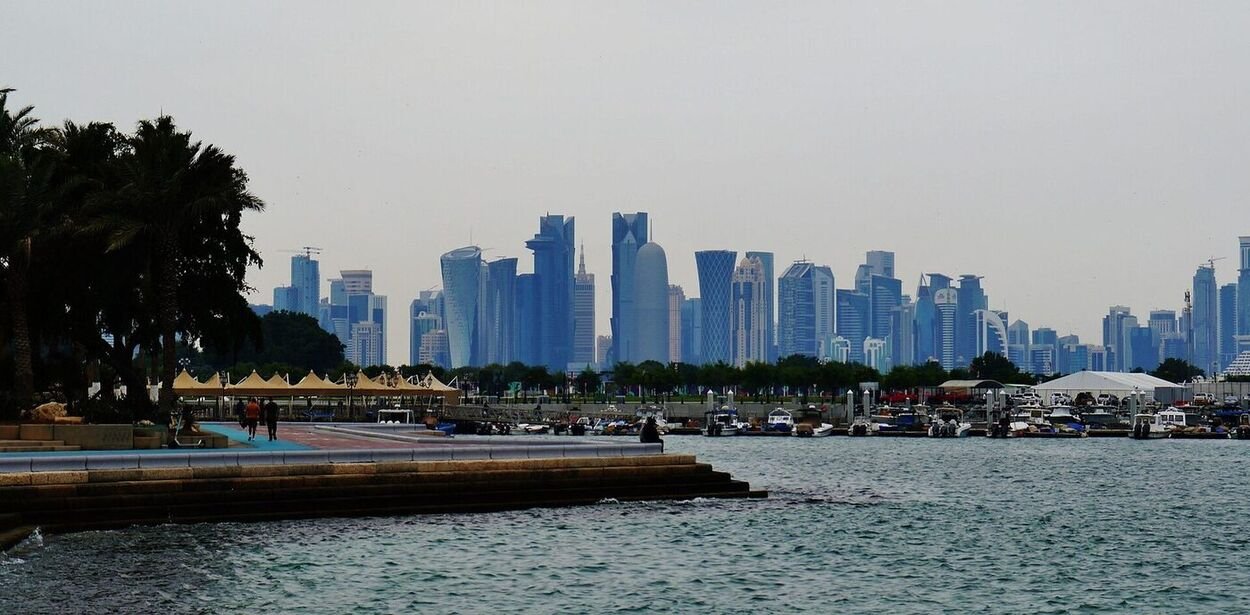
Doha delivery is a scheduled operation, and families are often surprised by how much of it depends on them rather than on us. Compounds run a manned gate, and the crew names, identity documents and vehicle details go to security in advance; a truck that turns up unlisted waits outside. Towers on The Pearl, in West Bay and across Lusail control the goods lift, which is booked with building management for a set window, and furniture does not travel in resident lifts. Several buildings restrict moving days or hours entirely. Where a full container cannot reach the door — narrow compound roads, low basement clearance, or a tower with no accessible bay — the load is transferred to a smaller vehicle at a shuttle point, which costs time and needs to be planned for rather than discovered.
What makes this straightforward is asking the building for its rules the week the tenancy is signed, and passing them to the coordinator. What makes it painful is discovering on the day that the lift was booked by another resident. The container has to be returned to the port empty and rescheduled, and that is a charge nobody enjoys explaining.
Appliances, voltage and the Gulf summer
The good news on this corridor is that there is no voltage problem. Qatar’s supply runs at 240 volts, 50 hertz, close enough to India’s 230 volts at the same frequency that appliances work as designed. The difference is the socket: Qatar uses the British three-pin Type G outlet, so Indian Type C, D and M plugs need adapters, or ideally rewiring by an electrician after arrival, because a shelf of loose adapters behind a fridge is a fire risk rather than a solution. Televisions, audio equipment, kitchen appliances, air conditioners and washing machines all transfer without modification.
The Gulf summer is the real constraint, and it applies to the voyage rather than the destination. A container crossing in June or July reaches temperatures that candles, cosmetics, vinyl records, sealed batteries, some adhesives and certain electronics do not tolerate well. Wooden furniture with glued joints can move. Anything of that kind is better sent by air or left behind, and the survey is the point at which to say so.
Insurance on a short crossing
People shipping to Doha sometimes reason that a passage of a week or two carries less risk than a passage of six, and decline cover accordingly. That misreads where the risk sits. Damage in household moving overwhelmingly happens during handling — the lift onto the vehicle in India, the stuffing of the container, the discharge at Hamad Port, the carry into a fourth-floor apartment — and a household consignment on this lane goes through as many handling events as one bound for Europe. The voyage is the safest part of the journey.
All-risk marine cover is priced against a declared value, which means the valued inventory is not a formality. A list that says “crockery” and a number is worth very little at claim stage; a list that itemises what is in the carton is worth what it says. Total-loss-only cover is cheaper and covers the outcome that almost never happens while excluding the ones that occasionally do. We explain both, we quote both, and we do not pretend that a short lane is a low-risk lane.

Storage: which end, and for how long
Storage on this corridor is cheaper in India than in Qatar, and that single fact should shape the decision. If the Doha home is not confirmed, the better answer is usually to pack, inventory and export-prepare the household in India and hold it there until the address exists, rather than to sail and store at the far end. Origin storage also keeps the option of adding to the consignment, which destination storage does not.
Destination storage earns its place in one situation: the address is confirmed but not yet available, and the gap is short. In that case, holding at Hamad Port or in a Doha facility for a couple of weeks avoids paying for a second inland leg. Where the gap is longer or genuinely open-ended, the container is better held in India. Either way, the storage decision is made explicitly with a review date attached, because the expensive version of storage is the one that quietly continues after everyone has stopped thinking about it.
Questions families ask about the Doha move
Should anything travel with us on the flight?
Documents, medicines, jewellery, laptops, chargers, a fortnight of clothing and anything genuinely irreplaceable. Those categories are not covered by a household consignment in any useful sense and should not be in it. Everything else is better in the shipment, where it is inventoried, insured and handled by people whose job it is.
How much notice do you actually need?
Six to eight weeks is comfortable for a full household from any Indian city. Four weeks is workable. Under two weeks means air freight for what matters and a sea consignment following later, which is a legitimate plan but a more expensive one. The Indian export documentation is the part that will not compress, and it is worth starting the conversation before the flights are booked rather than after.
Will everything be unpacked on delivery day?
Cartons are opened, contents placed on a flat surface or into the cupboard you indicate, furniture reassembled and positioned, and packing debris removed. What does not happen on delivery day is a fully arranged home — deciding where things live takes longer than a crew can wait, and most families prefer to do that themselves once the boxes are gone.