
Household & Personal Moves to Ireland
Moving your home from India to Ireland — Indian customs export, sea or air freight to Dublin, and EU Transfer of Residence clearance managed from start to finish.
A household move from India to Ireland is typically the result of a carefully considered decision: a role in Dublin or Cork accepted, a university place confirmed, family members already settled in Dublin or Cork, or the EU access that Irish residency provides. By the time the move itself is planned, the life question has been resolved. What remains is moving a household from India — with all the documentation, freight and customs complexity that entails — so that it arrives in Ireland intact, on time, and cleared without an import problem at Dublin Port. That is what Seemleius household and personal relocation from India to Ireland is built to deliver.
Export from India — the step that most people underestimate
Relocating household goods from India on a long-term or permanent basis is not simply a matter of packing and booking a container. Indian Customs requires a shipping bill to be filed at the gateway port before goods can be exported, and the commodity descriptions and values declared in that shipping bill form the basis of the Irish import declaration at Dublin Port. If they do not match — if the Indian paperwork is vague, inaccurate or filed for the wrong category of goods — Irish customs will ask questions before releasing the shipment. We prepare the Indian export documentation with the same care as the Irish import declaration, because consistency between the two is what makes clearance routine.
FEMA (Foreign Exchange Management Act) regulations apply to families emigrating from India; we provide context on the relevant compliance framing so your export is aligned with both the customs and the foreign-exchange regulatory environment.
The right Indian gateway depends on your origin city:
- Mumbai, Pune and western India — Nhava Sheva (JNPT)
- Bengaluru, Chennai and Hyderabad — Chennai Port
- Gujarat and Rajasthan — Mundra
- Kerala and the southwest — Cochin
- Delhi and NCR — JNPT by sea, or air freight from Indira Gandhi International (DEL) for priority items
Sea freight vs air freight from India to Ireland
The principal route for an India-to-Ireland household move is sea. A full-container load (FCL) from JNPT to Dublin Port runs approximately four to five weeks; from Chennai the routing is similar, potentially slightly longer. Consolidated (LCL) sea freight is available for smaller volumes. Air freight from Mumbai, Bengaluru or Chennai reaches Dublin in a day or two — practical for a small essentials shipment or for items needed immediately, less practical for an entire household given the per-kilogram pricing. Most families use a split approach: a small air consignment for the items they cannot manage without, and the main household by sea.
Irish customs and Transfer of Residence relief
Ireland, as an EU member, offers Transfer of Residence (ToR) relief on household goods imported by people establishing a new primary residence. The relief can eliminate or substantially reduce customs duty and VAT on personal effects that have been owned and used for a qualifying period outside the EU. The eligibility conditions are specific — broadly, the goods must have been owned and used for at least six months prior to the move, and the applicant must be establishing a normal residence in Ireland. We guide you through the documentation required to support a ToR claim and prepare it alongside your customs declaration so the relief is applied correctly from the start.
Indian export clearance
Shipping bill filed at your Indian gateway port, with commodity descriptions consistent with the Irish import filing and FEMA emigration context observed.
Export-standard packing
Packing materials and methods rated for four-to-five weeks at sea, with fragile items crated and electronics moisture-protected for the transit.
Transfer of Residence guidance
ToR relief eligibility assessed and documentation prepared so the Irish customs declaration supports your claim correctly from the outset.
Delivery and unpacking
Customs-cleared delivery to your Dublin, Cork or Galway address, with unpacking and placement so you arrive to a home rather than a collection of sealed cartons.
How your household move runs
- Survey and assessment. We assess your home in India and confirm volume, recommend sea or air freight (or a combination), and explain the Indian export and Irish import steps for your specific situation.
- Indian export and packing. The shipping bill is filed at your gateway port; our crew packs to export standard and builds the full inventory. Export documentation is completed before the container is sealed.
- Sea or air transit. The shipment travels to Dublin; Irish customs and ToR documentation is prepared during the transit window so it is ready to file on arrival.
- Irish customs and delivery. We manage EU clearance, including Transfer of Residence relief, and arrange delivery, unpacking and placement at your Irish address.
Indian families moving to Ireland often ask about the timing around a confirmed start date or a university term. We build the shipping timeline around your specific dates. Request your quote and we will plan the move around both your Indian departure and your Irish arrival.
Your dates, and the leg in the middle you cannot see
The four-to-five week figure quoted for a sea move to Ireland is not one voyage. It is a main-line sailing from your Indian port to a hub in North Europe — Rotterdam, Antwerp or Le Havre — and then a short-sea feeder from that hub into Dublin Port. There is no direct container service between the two countries, and there has not been one for a long time. Since the United Kingdom left the EU customs union, routings that once crossed Britain have largely fallen away too, because sending a container of your own belongings out of EU territory and back into it again adds British formalities that nobody wants on a household shipment. Staying on the continental side means one Irish import declaration and nothing else.
For a family planning dates, the consequence is specific. The feeder into Dublin does not sail daily. If the main-line vessel arrives at the hub a day late and the connection is missed, the shipment waits for the next feeder, and that gap is usually three or four days rather than one. This is why any honest quotation gives you a window rather than a date, and why a coordinator confirms the actual routing at booking rather than reciting an average.
Plan around the window rather than its optimistic end. Book the sailing so the container berths a fortnight or so after you land, not the day after. That gives room for the clearance formalities, room for the feeder to misbehave, and room for the practical fact that unpacking a household into an address you have lived in for two weeks goes considerably better than unpacking into one you collected the keys to that morning.
What is worth shipping to Ireland, and what is not
Some of this is different from the advice families are given for Gulf or North American moves, so it is worth going through properly.
Electrical goods travel better than people expect. India and Ireland both run at 230 volts and 50 hertz, so an Indian mixer grinder, wet grinder, induction hob, iron or television works in a Dublin kitchen without a transformer. What differs is the plug: Ireland uses the fused three-pin BS 1363 socket, India does not. The correct fix is to have each appliance fitted with a proper fused Irish plug — not to leave a travel adaptor permanently in the wall, which is both a fire risk and the reason a landlord will object. A wet grinder or a good pressure cooker is worth shipping on those terms alone; replacing Indian kitchen equipment in Ireland is possible but neither cheap nor like for like.
Solid-wood furniture is usually worth the space. Teak and sheesham cost a great deal more in Ireland than in India and the quality on offer at the same money is not comparable. The caution is dimensional rather than legal: Dublin’s older housing stock — Georgian and Victorian terraces, converted flats with turning stairs and narrow returns — defeats large single-piece wardrobes and long dining tables with regularity. Anything that dismantles will be fine. Anything that does not should be measured against the doorway and the stair turn before it is packed, and that measurement belongs in the survey.
Food and plants are the two categories to leave behind. The EU prohibits personal consignments of meat and dairy products from outside the bloc, without exception for small quantities and without exception for home-made. Ghee, paneer, milk sweets and anything containing meat all fall foul of it. Plants and plant material generally require a phytosanitary certificate to enter the EU, which in practice puts cuttings, seeds and the tulsi plant out of reach. Dry spices, pulses, tea and packaged commercial goods are ordinarily manageable when declared accurately on the inventory, but they should be declared — an undeclared food carton is the fastest route to a full examination of everything behind it.
Gas appliances need thinking about. An Indian hob is jetted for the LPG cylinder it was sold with. It can often be converted, but that is a job for a registered installer in Ireland, and for a modest hob the conversion plus the fitting frequently costs more than a new appliance. The pressure cooker, of course, comes.

Packing against monsoon damp and an Irish winter
A container loaded in Kochi in July and opened in Dublin in September has spent five weeks as a sealed steel box swinging between warm days and cold nights. Moisture in the air inside condenses on the roof and runs back down onto whatever is beneath it. This is ordinary container physics rather than bad luck, and it is why export packing for this corridor is not the same job as packing for a move across Mumbai.
What that means in practice: cartons that hold their structure when the air is humid rather than the single-wall kind; polythene and moisture-barrier wrap around upholstery, mattresses and anything textile; desiccant inside the container rather than only inside the boxes; electronics bagged and sealed rather than simply wrapped; and mirrors, marble and glass crated in timber rather than blanket-wrapped and hoped for. Brass and copper — the lamps, the urulis, the puja items that most Indian households ship — tarnish in a damp container and are better wrapped individually against acid-free paper than packed in bulk.
Timber matters for a second reason. Solid-wood packing cases and crates entering the EU must be heat-treated and marked to ISPM 15, and untreated crating is found and acted on at European ports. Any crate built for your shipment should carry the mark. Your own wooden furniture is not affected by that rule, but it should be dry, clean and free of any organic residue before it is wrapped.
Then there is the other end. Irish houses are cooler and damper than most Indian ones, and solid timber that has spent its life in a dry air-conditioned interior will move a little in the first winter. Letting furniture stand in the room for a few days before final assembly, and not pushing wardrobes flat against an external wall, prevents most of the small problems that otherwise appear in February.
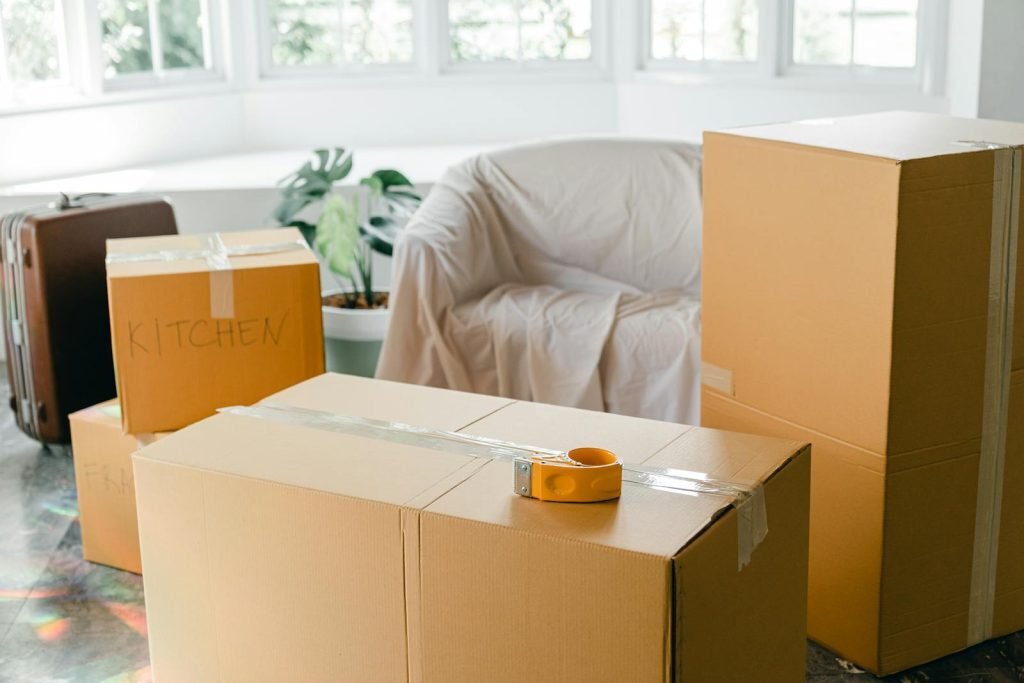
Delivery day on a Dublin street
The last two hundred metres of an India–Ireland move cause more trouble than the six thousand miles before them. A forty-foot articulated vehicle cannot reach most residential addresses in Dublin 6, Dublin 8 or Rathmines, and it cannot reach a great many in Cork city either. The normal answer is a shuttle: the container is stripped at a depot and the contents come to the door in a smaller vehicle. That is a planned cost when it is known at survey and an unpleasant surprise when it is discovered on the day.
Three things to establish before the delivery date is confirmed. Whether the street allows a removal vehicle to stand — in much of central Dublin that means arranging a parking bay suspension with the local authority, and those take notice rather than a phone call on the morning. Whether an apartment building requires its lift to be booked and protected, and whether it insists on particular hours; managed blocks in the docklands and in Sandyford commonly do both. And what the stairs will actually take: the turn at the half-landing in a period terrace is the measurement that decides whether a wardrobe goes up whole, goes up in pieces, or goes back on the van.
Unpacking is worth taking on the same day rather than deferring. Cartons opened and flattened while the crew is present means the packing material leaves with them instead of filling a rented hall for a fortnight, and it means anything damaged in transit is seen and recorded immediately rather than found in March when a claim is harder to make.
What families ask before they book
How much of the house should we actually ship?
More than most people assume, on this particular lane. Irish rental stock is often let unfurnished or part-furnished, and replacing a household in Dublin at Irish retail prices is expensive enough that a full twenty-foot container frequently costs less than rebuying its contents. The honest exceptions are mattresses, which are bulky and cheap to replace, and any large item that will not physically enter the destination.
Can we ship before we have an Irish address?
You can, and a lot of families do — Dublin’s rental market makes it common. The shipment is cleared on arrival and the contents go into warehousing until the address is settled, with a part-delivery of essentials to a short-term let if that helps. It is worth talking through the sequencing at survey rather than mid-voyage, because the timing of your own arrival relative to the container’s affects how the customs formalities on used household effects are handled.
What happens to the jewellery?
It does not go in the container. Gold and high-value jewellery travel with you, with the declarations that carrying them requires attended to on your side. A household consignment is the wrong place for anything irreplaceable, and no marine cover on a sea shipment is written on the assumption that it holds a family’s gold.
Is Cork or Galway more expensive to deliver to than Dublin?
Slightly, and only for the road leg. The consignment lands at Dublin Port either way and is hauled from there, so a Cork or Galway address adds a few hours of driving and the cost that goes with it — not a different sailing, a different clearance or a different transit. Anyone quoting a large premium for a Munster or Connacht delivery should be asked to itemise it. Ask for a survey and the figure comes back with the shuttle, the storage and the delivery leg shown as separate lines rather than buried in a single number.