
Indian businesses establishing a presence in Cyprus face a move that sits inside a larger project: company registration with the Registrar of Companies, tax registration and a Tax Identification Number from the Tax Department, VAT registration where the activity requires it, EORI registration for cross-border trade, local banking, employee residence and work permits, and the lease at the chosen address. The physical relocation of office equipment, commercial goods and operational infrastructure cannot be the component that introduces delay or uncertainty. Seemleius corporate and office relocation from India to Cyprus is planned as an operational project — sequenced, documented and managed so that the Cypriot office is ready when your team arrives, and the dependencies between corporate setup and physical setup are visible from the outset.
Why India–Cyprus corporate moves require both-end expertise
A corporate move is not simply a large household shipment. Office furniture and IT equipment are relatively straightforward; what adds complexity on the India–Cyprus corridor is the dual customs environment. India’s export side requires a shipping bill filed on ICEGATE, AD code registration, commercial valuation supported by invoice, and any applicable GST treatment (LUT for zero-rated export, or the GST refund route where appropriate). Cyprus’s import side applies the EU Common Customs Tariff, EU import VAT, EORI verification and HS code scrutiny by the Department of Customs and Excise. An error at either end can result in a shipment held at Limassol — and a held shipment means a delayed office opening, a stalled fit-out timeline and an HR team explaining to relocating staff why their workstations are still in port. We prepare both ends of the documentation chain in parallel, so there is no gap between what India exports and what Cyprus imports.
Indian commercial export
ICEGATE shipping bill, AD code registration, commercial export documentation and GST treatment (LUT or refund route) confirmed with Indian Customs — correct classification and valuation from the India end, before the cargo moves.
Office furniture & fit-out
Workstations, storage, meeting furniture and specialist equipment dismantled, packed, shipped and reassembled to your Cypriot floor plan — with awareness that older buildings in Nicosia and Limassol vary in lift capacity and access.
IT decommissioning & recommissioning
Systems decommissioned to a documented inventory at the India end, packed and sequenced for transport, and structured recommissioning at the Cypriot destination so your operation comes back up correctly.
Cyprus EU import clearance
HS codes, commercial invoice, EORI and the import declaration prepared precisely for the Department of Customs and Excise — with EU import VAT addressed correctly and end-use clarified for any sensitive equipment.
Indian corporate destinations and their Cyprus counterparts
The India–Cyprus corporate corridor tends to run between specific city pairs that reflect the sectors most active on the island and the strengths of the originating Indian cities:
- Bengaluru / Hyderabad → Limassol — technology, software and digital services companies establishing European operations in Limassol’s expanding technology and corporate cluster
- Mumbai / Delhi NCR → Nicosia — financial services, fund administration and professional services businesses entering Nicosia, the island’s administrative and institutional centre
- Mumbai → Limassol — shipping, ship management and maritime services companies basing in Limassol, one of the Mediterranean’s notable ship-management hubs
- Delhi NCR / Bengaluru → Limassol or Paphos — trading, e-commerce and holding companies using Cyprus as an EU base, often near the coastal business districts
- Ahmedabad / Surat → Limassol — manufacturing and trading businesses establishing distribution and import operations close to the island’s principal port
The Cypriot workplace context
An Indian business opening in Cyprus inherits a regulatory environment shaped by EU labour standards alongside Cypriot national law. Employment terms, working-time rules, annual leave and termination provisions are governed by Cypriot legislation, and the recruitment of non-EU staff — including transferring Indian employees — runs through residence and work permit procedures that should be understood before signage goes up. Public holidays in Cyprus follow a calendar that differs from India’s, which affects when delivery and installation can practically take place. The working environment is English-friendly, which eases the transition for Indian teams, but the administrative sequence is its own discipline. We are a relocation partner, not an immigration adviser. None of this is ours to advise on, but it shapes the physical schedule: we plan installation and IT recommissioning around the days that are practically available, and we coordinate with your Cypriot legal or HR adviser where the move timeline intersects employment obligations.
How a corporate move from India to Cyprus runs
- Survey both premises. We assess the India office and gather the Cypriot destination details — floor plan, building access, lift capacity, IT topology, structured cabling and any equipment that needs special handling.
- Build the move schedule. The plan is built around the operational window: the India decommission date, the sea transit through Limassol, customs clearance, and the Cypriot office opening date — with public-holiday and access constraints designed in, not discovered late.
- Prepare documentation. ICEGATE shipping bill, AD code, GST treatment, EORI and the Cyprus import documentation prepared simultaneously from the same verified inventory and valuation.
- Pack, ship and clear. The shipment moves from Nhava Sheva, Mundra, Chennai or Cochin; we monitor transit and manage clearance with the Cyprus Department of Customs and Excise at Limassol.
- Install and commission. The Cypriot office is set up to the agreed floor plan and systems are recommissioned so your team can operate from day one, with the IT recommissioning documented for handover.
India–Cyprus corporate relocations work best when planning starts early enough for the export documentation to be prepared without pressure and the Cypriot fit-out to absorb access and holiday constraints — the same discipline that runs through our wider India to Cyprus moving service. Talk to us about your timeline and we will build the schedule around it.
What moves well from an Indian office, and what to leave behind
Not everything in a Bengaluru office deserves a place in a container to Limassol, and the survey is where that conversation happens. Workstations and desking that dismantle flat travel well and reassemble cleanly; so do filing cabinets, safes (with the combination handed over separately), meeting tables, whiteboards and glass partitions if crated. Monitors, laptops, desk phones and networking hardware are dense, valuable and easy to pack, and India’s 230-volt supply matches Cyprus’s, so nothing electrical needs a transformer. What does need attention is the plug: Indian Type D and Type M plugs do not fit Cypriot Type G sockets, so every desk gets adaptors or new leads on installation, and we build that into the recommissioning list rather than leave it for someone to discover on the Monday.
What tends to stay behind is the cheap and the awkward. Locally made modular furniture often costs more to ship than to replace from a Limassol supplier, and it may not suit a smaller European floor plate anyway. Lead-acid UPS batteries and large lithium packs are dangerous goods that complicate the whole box; most clients buy new in Cyprus. Printers travel, but toner and ink are removed. Servers travel, but should be imaged and backed up before they leave the rack, because a container is not a controlled environment for three weeks. Plants, naturally, do not go.
Where the offices are, and what access looks like
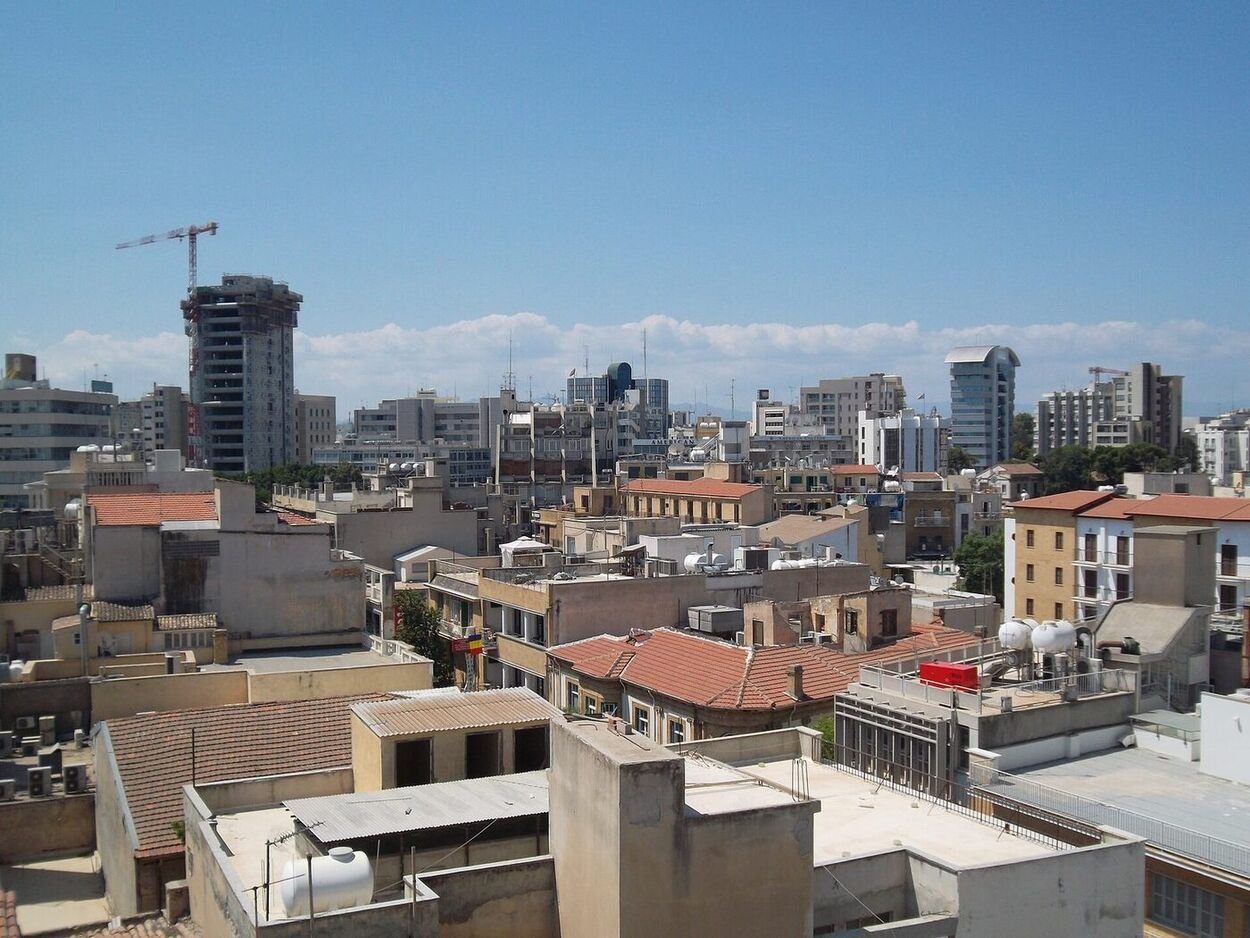
Limassol’s corporate life has moved to the seafront. The towers along the Molos and the coastal road towards the marina house the ship-management, forex and technology firms that Indian companies tend to sit alongside, and they are modern buildings with goods lifts, loading bays and building managers who want a delivery booked in advance and a certificate of insurance on file. Nicosia is different: professional-services firms cluster around Makarios Avenue and the newer blocks off the ring road, and some of the older buildings there have small lifts, narrow stairwells and street parking only. A 40-foot container cannot be worked from a Nicosia side street, so the box is stripped at our partner warehouse in Limassol and the office arrives on smaller vehicles across two or three trips.
The municipality has to approve anything that blocks a lane, and approval is quick but not instant. Summer makes access harder, not easier: Cypriot building managers will not have crews carrying steel cabinets through an August afternoon, and neither will we, so installation starts at seven and finishes early. Mid-August is also when much of the island is on holiday, and an office fit-out planned for that fortnight will find the electrician and the cabling contractor away. We build the installation around the days that actually exist on the Cypriot calendar.

A corporate move on a calendar
| When | What happens |
|---|---|
| Ten to twelve weeks out | Survey of the Indian office; destination details from the Cypriot landlord or fit-out contractor; inventory and valuation agreed with finance |
| Eight weeks out | Move plan issued: decommission date, sailing, feeder into Limassol, clearance window, install dates; sea space booked |
| Six weeks out | Export documentation drafted from the inventory; HS classification of IT hardware confirmed; Cypriot importer’s EORI verified |
| Three weeks out | Pre-packing of archives, non-essential furniture and spare equipment; live desks stay live |
| Decommission weekend | Systems shut down to the documented inventory, packed, container stuffed and sealed; shipping bill filed; Let Export Order |
| Transit | Three to four weeks Nhava Sheva to Limassol via Port Said or Piraeus; coordinator tracks the transhipment |
| Arrival week | Entry lodged with the Department of Customs and Excise before berthing; duty and VAT settled; release and delivery |
| Install week | Furniture assembled to the floor plan, IT recommissioned and signed off, adaptors fitted, packaging removed |
The gap that hurts most is between decommission and install. Few businesses can be offline for four weeks, which is why most India–Cyprus corporate moves run two sites in parallel for a period, with the Cypriot office equipped with a temporary core — laptops, a router, a few desks bought locally — while the container is at sea. Where the Limassol lease starts before the goods can land, our partner warehouse holds the shipment under bond or after clearance until the fit-out is ready, and we deliver in the order the office needs it: server room first, reception last.
How the corporate quote is built
A corporate quote is priced on labour and on volume, and the two do not always move together. Volume in cubic metres sets the container and the ocean rate; labour sets the decommissioning and recommissioning days, the crating hours for glass and equipment, the number of installers in Cyprus and the number of days they are needed. A thirty-desk office with a small server room is, on paper, a single 40-foot container; in practice it is also two days of IT work in Bengaluru, three days of assembly in Limassol and a network engineer on site for the cut-over. Customs duty on used office equipment is assessed on the declared value, which is why the inventory valuation is agreed with your finance team before the shipping bill is filed, not estimated by a packer on the day. Storage at Limassol, if the lease slips, is priced per week and is the one line that can grow after the quote is signed, so we flag the trigger for it in writing.
Questions from businesses opening in Cyprus
Can the move run in phases?
It usually should. Archives, spare equipment and furniture for desks not yet hired go in a first container while the Indian office is still working; the live desks, the server room and the people follow in a second, smaller shipment or by air. Two phases cost more in port handling and a little less in downtime, and for most Limassol openings the downtime is the more expensive of the two.
Is it cheaper to ship the office or buy new in Limassol?
For furniture, often the latter, unless the pieces are good and the volume is already justified by equipment. For IT hardware, shipping almost always wins, because the kit is configured, licensed and known. The survey gives you the comparison in cubic metres and rupees so the decision is made on numbers.
Can the shipment be held until the lease is signed?
Yes. Storage in Limassol is arranged in advance rather than improvised on the quay, and the entry can be lodged from storage once the importing entity and its EORI are in place.
Who is the importer of record in Cyprus?
Normally the Cypriot company, which needs to exist and hold an EORI before the entry is lodged. Where the Cypriot entity is still being formed when the container is due, we plan the storage and the entry timing around that, and the sequencing is agreed with your corporate-services provider on the island.