
- 20+ years moving households & cargo
- 184 countries destination corridors covered
- In-house customs clearance filed by our own team
- One coordinator from quote to delivery
The Comoros is a small island nation in the Indian Ocean, set between the East African coast and the northern tip of Madagascar. Made up of three main islands — Grande Comore, Anjouan and Mohéli — it draws a modest stream of movers from India: development and healthcare professionals, traders, and individuals with family or business ties to the islands. Moving household goods to a small Indian Ocean archipelago is a specialised task, and Seemleius is set up to handle it carefully.
Although the Comoros lies in the same ocean as India, it sits well off the principal east–west shipping lanes, so almost every shipment reaches it by transhipment rather than on a direct service. The work is to clear the goods correctly in India, route them through a regional hub, and arrange the final island leg. Getting the India end precise is what keeps that chain moving smoothly.
The India–Comoros corridor
Export clearance in India begins with the shipping bill filed on ICEGATE, AD code registration with the loading port and export-standard packing. Sea freight departs from Nhava Sheva (JNPT), Mundra, Chennai or Cochin and is routed via a transhipment hub — commonly a port in the Gulf, Mombasa, or a hub serving the Mozambique Channel — before the final leg to the Port of Mutsamudu on Anjouan, the country’s deep-water port, or the port at Moroni on Grande Comore. Start-to-finish sea transit is typically in the range of 25 to 40 days depending on hub connections. Customs clearance is handled by the Comorian customs administration (Direction Générale des Douanes), which administers import duty, VAT and the conditions for relief on used personal effects under transfer-of-residence provisions.
Air freight from Mumbai (BOM), Delhi (DEL), Bengaluru (BLR) or Chennai (MAA) reaches the Comoros through Prince Said Ibrahim International Airport (HAH) near Moroni, routed via Nairobi, Dar es Salaam or a Gulf hub. Air suits urgent or compact consignments; we explain the cost premium over sea honestly.
Indian export clearance
Shipping bill filed on ICEGATE, AD code registration, FEMA-aware documentation and customs clearance at Nhava Sheva, Mundra, Chennai or Cochin — so your goods leave India correctly for the islands.
Transhipment routing
Shipments route via a Gulf or East African hub before the final leg to Mutsamudu or Moroni — we manage the hub connection and the schedule.
Comoros customs
Clearance with the Comorian Direction Générale des Douanes, duty and VAT treatment confirmed in advance, and transfer-of-residence relief on used effects claimed where eligible.
Inter-island delivery
Where your destination is not the port of entry, we arrange the onward inter-island leg to Grande Comore, Anjouan or Mohéli.
Who moves on this corridor
The India–Comoros route serves several kinds of movers. Households include development, healthcare and education professionals, traders, and individuals with family or business connections to the islands. Business and office moves arise as Indian firms in trade, services and healthcare establish a small footing. Commercial freight covers equipment, project cargo and supplies for development and private projects. This single corridor page serves all three; your coordinator tailors documentation and routing to your consignment.
Where we deliver in the Comoros
We deliver to Moroni, the capital and largest city, on Grande Comore; Mutsamudu, the main port town on Anjouan; Fomboni on Mohéli; and the smaller towns across the three islands including Domoni and Mitsamiouli. Moroni and Mutsamudu handle most moves; for the other islands and smaller towns we arrange the inter-island leg as part of your quote.
How your move works
- India-side survey. We assess volume and contents at your home or office in India — in person or by video — and return a clear quote with sea and air options and realistic island arrival windows.
- Export documentation. Indian export paperwork is prepared: shipping bill filed through ICEGATE, AD code confirmed, packing list, invoice and any FEMA-related declarations.
- Pack and dispatch. Our crew packs to export standard from your India origin, and the shipment is booked and dispatched via the transhipment hub to Mutsamudu or Moroni.
- Clear and deliver in the Comoros. We manage import clearance, advise on transfer-of-residence relief, and coordinate final delivery — including any inter-island leg — to your address.
To start a move from India to the Comoros, request a quote and your coordinator will walk you through the documentation, routing and timeline.
Getting a container to a small island
We will start with the thing that shapes everything else on this corridor: the Comoros is small, and the volume of cargo moving there from anywhere is modest. There is no weekly groupage box from India, no direct sailing, and no shipping line that treats Moroni as a mainline call. The number of Indian households moving to the islands in a given year is small enough that we can say, plainly, that this is a corridor we plan one shipment at a time.
What that means physically is a two-stage voyage. The container leaves Nhava Sheva, Mundra, Chennai or Cochin on a mainline service to an East African hub — Mombasa or Dar es Salaam most often, occasionally Port Louis in Mauritius or a Gulf port such as Salalah or Jebel Ali — where it is discharged and waits for a feeder vessel serving the Comoros. The feeder is the crux. Feeders to Moroni and Mutsamudu run to loose schedules and sail when they have enough cargo, so a box that lands at Mombasa the day after one departs may wait a fortnight or more for the next. That single connection is why the sea window on this corridor is a range and why we spend more time tracking a Comoros shipment at the hub than we do at sea.
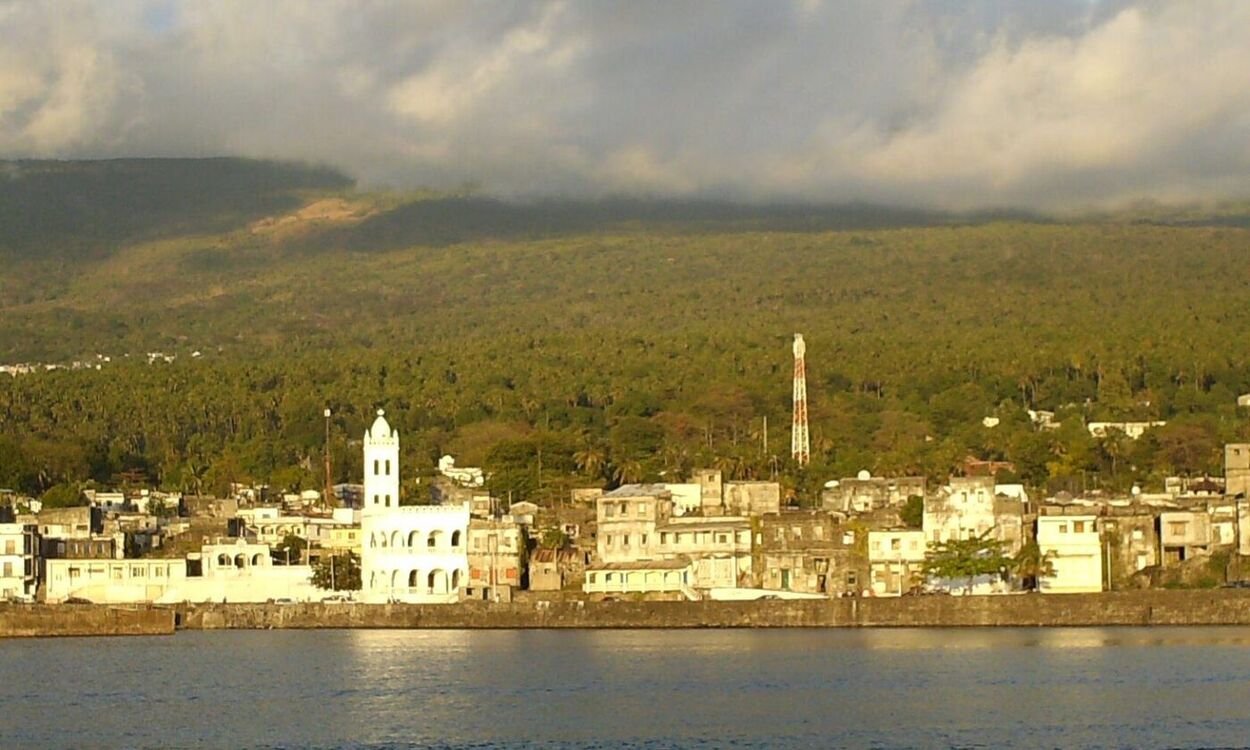
The islands’ ports are the second constraint. Mutsamudu, on Anjouan, has the country’s deep-water quay and takes the larger feeders. Moroni, on Grande Comore, has a smaller harbour where working cargo has historically depended on the weather and on lighters; feeders do call, but not always, and not always on time. Which port your container reaches depends on the feeder operator, not on us, and if it lands at Mutsamudu while you are in Moroni there is an inter-island leg by coastal vessel before the goods are on the right island. All of this is manageable; what it is not is fast, and we will not tell you otherwise.
Air is the alternative for essentials. Flights into Prince Said Ibrahim International Airport at Moroni connect through Nairobi, Dar es Salaam, Addis Ababa or a Gulf hub, and a few hundred kilos of clothing, kitchen basics and work equipment can be there within a week or two of leaving Mumbai or Chennai. For many of the families and professionals we move to the Comoros, a modest air consignment for the first weeks and a sea container for everything else is the shape of the move.
What to bring to the islands, and what to think twice about
Packing for the Comoros is packing for a humid tropical climate, a long wait in a hub port, and a destination where replacing a broken item is not a matter of visiting a shop the next morning. Both facts push in the same direction: bring what you will genuinely need, protect it well, and leave behind the bulky and the fragile.
Mould is the enemy. A container that spends three weeks at Mombasa and another on a feeder across the Mozambique Channel is warm and damp inside for most of that time. We seal mattresses, upholstered furniture, books, paper and textiles in film with desiccant, and we advise against shipping anything already carrying a hint of damp from an Indian monsoon home. Leather goods and wooden furniture with open grain are wiped, dried and wrapped. Electronics are bagged with silica gel and packed in the centre of the load, away from the container walls.
What tends to be worth shipping: kitchen equipment and the things that make an Indian kitchen work, since they are hard to find on the islands; a stock of factory-packed dry goods within what customs allows; small appliances (the Comoros runs on 220 volts, so Indian equipment plugs in, though a voltage stabiliser is a sensible companion given the supply); spare parts, chargers and consumables for anything you rely on; bedding, towels and clothing for a hot, humid year; and any professional equipment you need for your work. What tends not to be: large furniture that can be bought or made locally, glass-fronted cabinets, marble, and anything perishable or plant-based — customs will refuse plants, seeds and fresh produce, and a long stay in a hot container ruins the rest.
Grande Comore is a volcanic island, and its roads reflect that: narrow, steep in places, and rough outside Moroni. A 40-foot container does not go to a house in the hills. Goods are unloaded at the port or a nearby yard and delivered on small trucks, sometimes in more than one trip, and our island partner walks the access before the day so there are no surprises at a gate the truck cannot fit through. Vehicles are a separate conversation; used cars are imported into the Comoros in some numbers, mainly from the Gulf, and if you plan to ship one from India the customs conditions are checked for your specific vehicle before we quote.
A realistic timeline, stage by stage
Because the feeder connection is uncertain, we describe a Comoros move as a sequence of events rather than a date. The sequence runs like this.
- Survey and quote. A walkthrough of your Indian home or office, in person or over video, produces a quote showing a sole-use 20-foot container beside an air option. Groupage is rarely realistic on this corridor and we will say so if that is the case for you.
- Export documentation. Shipping bill on ICEGATE, AD code confirmed at the loading port, packing list and valued inventory prepared in a form the Comorian customs agent can file. Allow a week or two alongside packing.
- Packing and dispatch. Two or three days on site; the container is stuffed, sealed and gated in at the Indian port.
- Mainline to the hub. Roughly two to three weeks to Mombasa or Dar es Salaam, longer if the mainline routes via the Gulf first.
- Hub dwell. Anywhere from a few days to several weeks, depending entirely on when the next Comoros feeder sails. This is where the range in the schedule lives, and your coordinator will tell you the moment the box is confirmed on a feeder.
- Feeder to Mutsamudu or Moroni. A few days at sea across the Mozambique Channel.
- Comorian clearance. Import declaration lodged with the Direction Générale des Douanes, duty and taxes assessed in Comorian francs or relief applied on used effects where the conditions are met, physical inspection likely.
- Inter-island leg and delivery. If the port of discharge is not your island, a coastal transfer; then delivery by small truck, unpacking and debris removal.
Two seasonal notes. The Mozambique Channel has a cyclone season from roughly November to April, and feeders can be held in port for days when a system passes; the Indian monsoon from June to September affects packing days in Mumbai, Cochin and Chennai. Neither stops the corridor, but each can add a week, and we build that into the window rather than into an apology later. Taken together, a booking-to-delivery span of two to three months is a sensible planning assumption, with the shorter end achievable when the feeder connection lands well.
Frequently asked, about the Comoros
Can you guarantee which island my container will arrive at?
No, and we would be wary of anyone who did. The feeder operator sets the rotation, and it changes. What we do is book with the operator whose schedule best matches your island, tell you as soon as the port of discharge is confirmed, and have the inter-island transfer arranged in advance so it is a delay of days rather than weeks if the box lands on the other island.
Is there an Indian community to help me settle in?
A small one, and we say that plainly. There are Indian-origin traders and professionals in Moroni and Mutsamudu, and a small, long-established community of Gujarati-origin trading families, but not the dense diaspora you would find in Nairobi or Dar es Salaam. Practically, it means fewer places to buy Indian groceries and no established groupage flow from India — which is why we suggest shipping the kitchen and keeping the sea container sole-use.
What currency are duties paid in, and who pays them?
Comorian customs assesses duty and taxes in Comorian francs, which are pegged to the euro. Where the transfer-of-residence relief on used effects applies, the assessment is much reduced; where it does not — new items, commercial quantities — duty is payable before release. Our quote states which charges are included and which are assessed on arrival, so nothing is a surprise at the port.